
Mulch plays a bigger role in Port Stephens gardens than most homeowners realise. With sandy…
On-Site Detention in Newcastle: Do You Actually Need It?
Contents
- What is on-site detention?
- What Is On-Site Detention and How Does It Work?
- Which Newcastle Development Projects Trigger OSD Requirements?
- How Is OSD Tank Size Calculated for Newcastle Properties?
- Surface Basin vs Underground Tank — Which One Suits Your Site?
- What Happens If Your OSD System Isn’t Compliant?
- Getting OSD Right the First Time in Newcastle
- Ready to Get Your OSD Sorted Before You Lodge?
If you’re planning an extension, a new driveway, a dual occupancy build, or a subdivision in Newcastle, there’s a good chance your project will need to manage stormwater differently once it’s finished. This is where on-site detention comes in. Council requires many developments to hold back extra stormwater on the property itself, rather than sending it straight into the street system, and getting this requirement wrong can hold up your Development Application.
This guide explains what on-site detention is, which Newcastle projects typically trigger the requirement, how tank sizing is worked out for your site, and the difference between a surface basin and an underground tank. We’ll also cover what happens if a system doesn’t meet council standards, and how to get it right from the outset.
What is on-site detention?
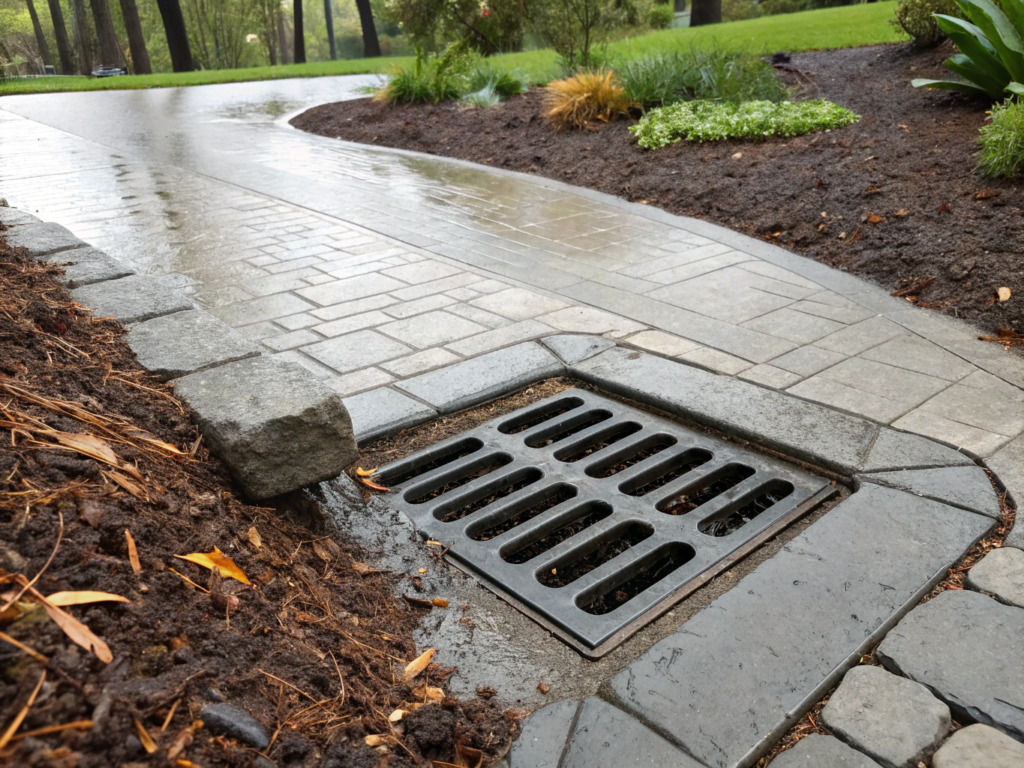
On-site detention (OSD) is a stormwater system that holds rainwater runoff on a property for a while before letting it out into the council drainage network at a controlled rate. It stops heavy rainfall from overloading public stormwater infrastructure and cuts down flooding risk for properties downstream.
A typical OSD system has three parts:
- Storage — a tank, underground chamber, or surface basin that captures excess runoff during rain
- Controlled outlet — a restricted opening that releases stored water slowly back into the stormwater system
- Overflow point — a safety outlet that activates during extreme rainfall, once capacity is exceeded
OSD systems are required because hard surfaces like roofs, driveways, and paving stop water soaking into the ground naturally, which speeds up and increases runoff. Unlike a rainwater tank, which stores water for household use, an OSD system empties out completely between rain events.
What Is On-Site Detention and How Does It Work?
Newcastle’s a city full of established suburbs, and a lot of that stormwater infrastructure under the streets went in decades ago. It wasn’t built for today’s level of hard surface. Every time a block gets a bigger roof, a new driveway, or more paving, that property sheds water faster than before. Multiply that across a suburb and council’s ageing pipes can’t cope with it all arriving at once.
That’s why council leans on OSD so heavily here. Each site holds its share of stormwater back and releases it slowly, so the network downstream isn’t hit all at once.
There’s relevant guidance under AS 3500, the Australian Standard for stormwater drainage, and council builds its own Newcastle requirements on top of that.
The process runs in sequence — rain falls, gets directed into storage, then released through a controlled outlet at a slow, steady rate into council’s system.

Which Newcastle Development Projects Trigger OSD Requirements?
Not every job needs OSD, but a fair few do. Council generally looks at how much extra hard surface or added density your project’s bringing to the site, and works from there under the City of Newcastle DCP and LEP.
Extensions and Additions
Adding a bedroom, a second storey, or extra living space usually means more roof area. More roof area means more runoff, and that’s often enough on its own to trigger the requirement.
New Driveways and Paving
A new driveway, a paved courtyard, or extra hardstand all reduce how much water soaks into the ground naturally. Council looks at this added impervious area closely.
Dual Occupancy and Subdivision
These projects increase site density, which means more runoff overall. They’re some of the most common triggers council flags.
Does your project trigger OSD?
- Adding roof or floor area
- New or expanded paved surfaces
- Dual occupancy or subdivision
- Increasing overall site density
How Is OSD Tank Size Calculated for Newcastle Properties?
Tank size isn’t a guess, and it’s not one-size-fits-all either. A few things go into working it out — site area, the percentage of hard surface across the block, catchment characteristics, the permissible discharge council allows for your site, and local rainfall intensity.
This gets run through council-approved software, usually something like DRAINS, and it’s done by a hydraulic engineer. It’s genuinely not a DIY job — get the sizing wrong and either the system won’t do its job in a storm, or you’ll end up with a tank bigger than it needs to be.
Rainfall figures come from Bureau of Meteorology data, cross-referenced against the relevant Australian Standard, so the numbers are grounded in what Newcastle actually cops.
What goes into the calculation:
- Site area
- Percentage of impervious surface
- Catchment characteristics
- Permissible site discharge
- Local rainfall intensity data
Surface Basin vs Underground Tank — Which One Suits Your Site?
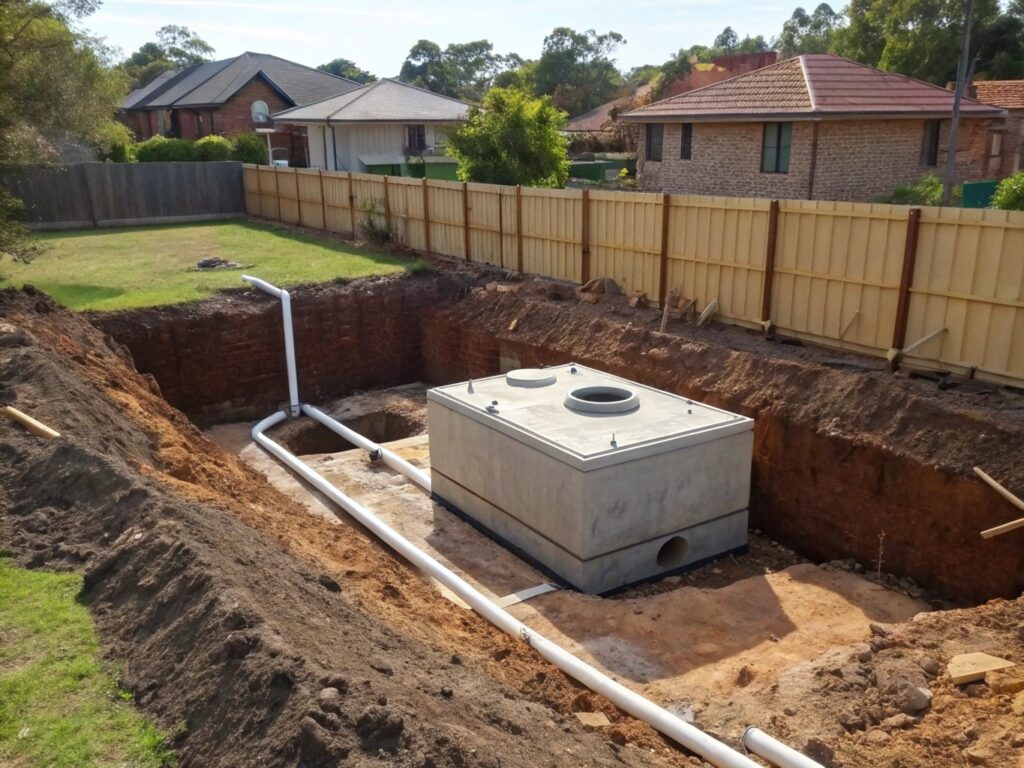
For a lot of Newcastle blocks, especially the tighter established ones in suburbs like New Lambton, Merewether, and Charlestown, an underground tank ends up being the more practical choice. There just isn’t the space for a surface basin without eating into the yard.
| Factor | Surface Basin | Underground Tank |
|---|---|---|
| Space required | Needs open yard area | Fits under driveway, lawn, or slab |
| Cost | Generally lower | Generally higher |
| Maintenance | Easier access, more visible | Requires access point, less visible |
| Aesthetics | Can look like a feature or a dip in the lawn | Hidden from view entirely |
| Small-lot suitability | Limited on tight blocks | Well suited to tight blocks |
If you’ve got the space and don’t mind a basin as part of the landscaping, it’s the cheaper route. If your block’s tight, which a lot of Newcastle’s established suburbs are, underground’s usually where people land.
What Happens If Your OSD System Isn’t Compliant?
Getting OSD wrong doesn’t just mean a paperwork headache, it can genuinely slow down the whole project. A non-compliant system can hold up your DA or Construction Certificate while council sends it back for changes, and that’s time most people building or extending don’t really have spare.
If it’s missed until after construction, retrofitting an OSD system into a finished job is a lot more costly than getting it designed in from the start. Digging up a driveway or garden that’s already in isn’t cheap.
It can also cause issues down the track at sale time. Conveyancing can flag non-compliant stormwater systems, which slows down a settlement nobody wants delayed. And there’s the downstream side of it too — if your system isn’t holding water back the way it should, that’s runoff heading straight to your neighbours’ properties, which carries its own liability.
Getting it right from the start avoids all of this.
Getting OSD Right the First Time in Newcastle
The simplest way to avoid all of the above is to bring a hydraulic or civil engineer in early, before your DA even goes in. Getting the design sorted upfront means council’s got what they need the first time round, rather than sending things back for revisions.
It’s also worth having a chat with council pre-DA if your project’s anything out of the ordinary. A quick conversation early can save a lot of back-and-forth later.
And when you’re budgeting for the build, factor OSD in as part of your site works from the outset rather than as an afterthought. It’s a lot easier to plan for the cost than to find it unexpectedly halfway through construction.
Ready to Get Your OSD Sorted Before You Lodge?
If you’re planning an extension, a new driveway, a dual occupancy build, or a subdivision anywhere in Newcastle, don’t wait until council sends your DA back to find out where you stand on stormwater. Landscaping Newcastle Pro can get you a quick site assessment early, so you know exactly what’s required before you spend a cent on design or construction.
Whether you’re DA-ready and need sizing sorted fast, or you’re still in early planning and just want to know if your project’s likely to trigger OSD, give us a call and we’ll walk you through it.
📞 Call Landscaping Newcastle Pro on 0240581214
No pressure, no jargon — just a straight answer on what your site actually needs


Comments (0)